Trusted Installer Windows 11 Best

The "TrustedInstaller" in Windows 11 represents a critical security architecture designed to prevent unauthorized or accidental modifications to core system files. While users often encounter it as a frustrating "Permission Denied" error when trying to delete folders, its primary role is to serve as the ultimate guardian of the Windows operating system. The Guardian of System Integrity

If you’re trying to “optimize” or “debloat” Windows 11 by deleting system files, you’re fighting the wrong battle. Use official methods (PowerShell to remove provisioned packages, Group Policy, or LTSC edition) instead of breaking TrustedInstaller’s guard. trusted installer windows 11 best

You can now modify, delete, or rename the file. The "TrustedInstaller" in Windows 11 represents a critical

: If you frequently need to run apps with TrustedInstaller privileges (like Registry Editor), use a tool like Run system repair tools (DISM, SFC)

The True Boss: IT professionals often joke that while you might own the hardware, TrustedInstaller owns the software. Are you currently seeing an "Access Denied" error, or TrustedInstaller: What It Is And Why It Matters? - Ftp

TrustedInstaller in Windows 11: The Definitive Technical Report

1. Executive Summary

TrustedInstaller (formally the Windows Modules Installer service, with the security principal NT SERVICE\TrustedInstaller) is the highest-level ownership and execution authority for core Windows 11 operating system files. It is a security feature designed to prevent malware, system corruption, and accidental user modifications from affecting critical system resources. Unlike the legacy SYSTEM account or local Administrator, TrustedInstaller has exclusive rights to modify, replace, or delete protected OS files (e.g., those in C:\Windows\System32, C:\Windows\SysWOW64, C:\Program Files\WindowsApps).

  1. Press Win + X > Terminal (Admin).
  2. To take ownership of a file (e.g., a custom hosts file blocker):
    takeown /f "C:\Windows\System32\drivers\etc\hosts"
    
  3. To grant your admin account full control:
    icacls "C:\Windows\System32\drivers\etc\hosts" /grant "%USERNAME%:F"
    
  4. Edit the file. After finishing, restore TrustedInstaller ownership:
    icacls "C:\Windows\System32\drivers\etc\hosts" /setowner "NT SERVICE\TrustedInstaller"
    

Guardian of Integrity: It owns almost all files in the C:\Windows and C:\Program Files directories.
Command line utility

A cross-platform console application that can export and decompile Source 2 resources similar to the main application.

ValveResourceFormat

.NET library that powers Source 2 Viewer (S2V), also known as VRF. This library can be used to open and extract Source 2 resource files programmatically.

ValveResourceFormat.Renderer

.NET library providing an OpenGL-based rendering engine for Source 2 assets. Standalone rendering of models, maps, particles, animations, lighting, and materials with physically-based rendering (PBR).

ValvePak

.NET library to read Valve Pak (VPK) archives. VPK files are uncompressed archives used to package game content. This library allows you to read and extract files out of these paks.

ValveKeyValue

.NET library to read and write files in Valve key value format. This library aims to be fully compatible with Valve's various implementations of KeyValues format parsing.

C#
// Open package and read a file
using var package = new Package();
package.Read("pak01_dir.vpk");

var packageEntry = package.FindEntry("textures/debug.vtex_c");
package.ReadEntry(packageEntry, out var rawFile);

// Read file as a resource
using var ms = new MemoryStream(rawFile);
using var resource = new Resource();
resource.Read(ms);

Debug.Assert(resource.ResourceType == ResourceType.Texture);

// Get a png from the texture
var texture = (Texture)resource.DataBlock;
using var bitmap = texture.GenerateBitmap();
var png = TextureExtract.ToPngImage(bitmap);

File.WriteAllBytes("image.png", png);
View API documentation
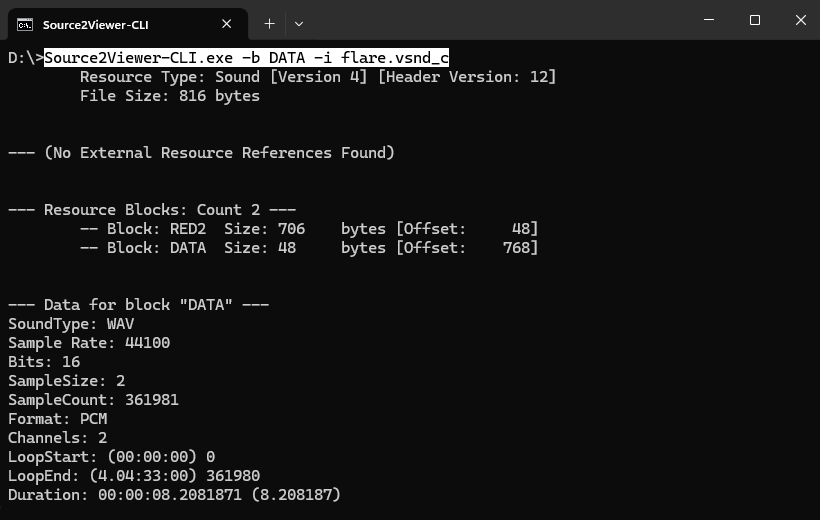
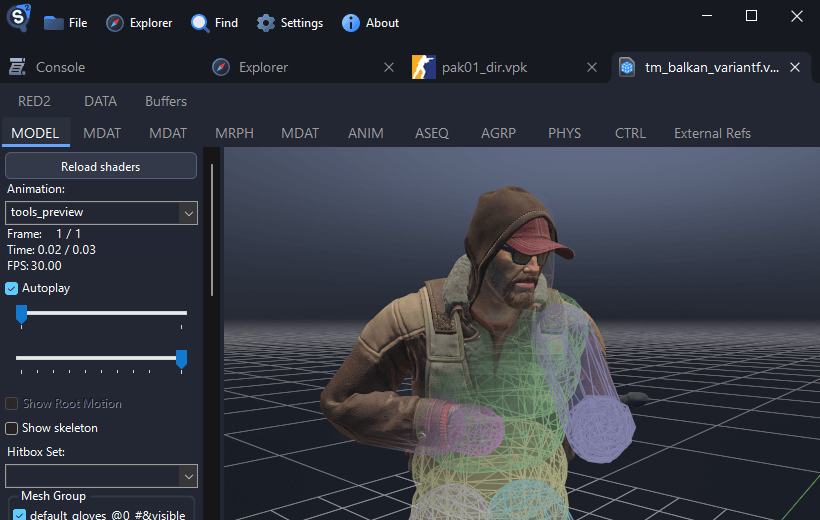
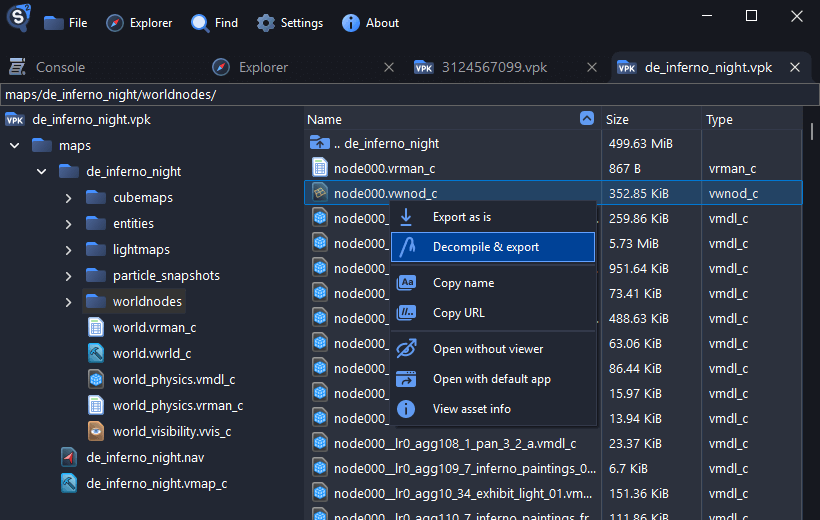
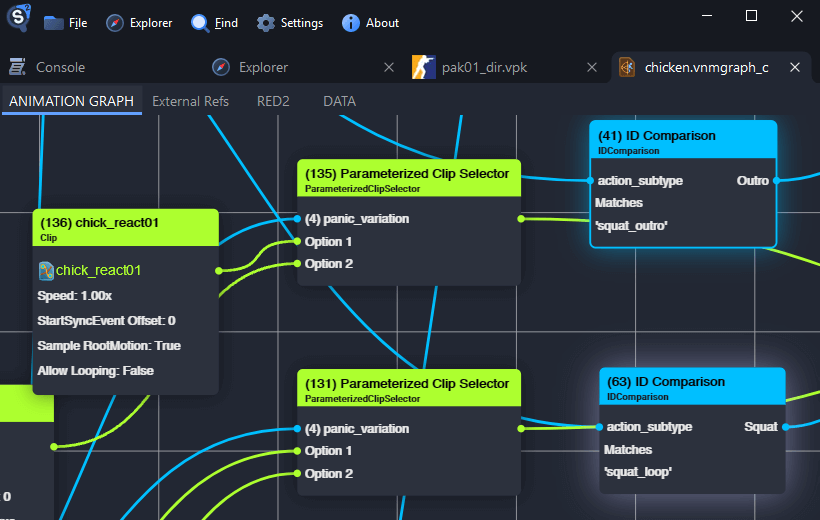
Screenshot of the 3D renderer displaying a Counter-Strike 2 player model on a grid Screenshot showing the VPK package explorer interface with a file tree and a list view Screenshot of the animation graph viewer showing nodes Screenshot of the command line interface showing DATA block for an audio file

The "TrustedInstaller" in Windows 11 represents a critical security architecture designed to prevent unauthorized or accidental modifications to core system files. While users often encounter it as a frustrating "Permission Denied" error when trying to delete folders, its primary role is to serve as the ultimate guardian of the Windows operating system. The Guardian of System Integrity

If you’re trying to “optimize” or “debloat” Windows 11 by deleting system files, you’re fighting the wrong battle. Use official methods (PowerShell to remove provisioned packages, Group Policy, or LTSC edition) instead of breaking TrustedInstaller’s guard.

You can now modify, delete, or rename the file.

: If you frequently need to run apps with TrustedInstaller privileges (like Registry Editor), use a tool like

The True Boss: IT professionals often joke that while you might own the hardware, TrustedInstaller owns the software. Are you currently seeing an "Access Denied" error, or TrustedInstaller: What It Is And Why It Matters? - Ftp

TrustedInstaller in Windows 11: The Definitive Technical Report

1. Executive Summary

TrustedInstaller (formally the Windows Modules Installer service, with the security principal NT SERVICE\TrustedInstaller) is the highest-level ownership and execution authority for core Windows 11 operating system files. It is a security feature designed to prevent malware, system corruption, and accidental user modifications from affecting critical system resources. Unlike the legacy SYSTEM account or local Administrator, TrustedInstaller has exclusive rights to modify, replace, or delete protected OS files (e.g., those in C:\Windows\System32, C:\Windows\SysWOW64, C:\Program Files\WindowsApps).

  1. Press Win + X > Terminal (Admin).
  2. To take ownership of a file (e.g., a custom hosts file blocker):
    takeown /f "C:\Windows\System32\drivers\etc\hosts"
    
  3. To grant your admin account full control:
    icacls "C:\Windows\System32\drivers\etc\hosts" /grant "%USERNAME%:F"
    
  4. Edit the file. After finishing, restore TrustedInstaller ownership:
    icacls "C:\Windows\System32\drivers\etc\hosts" /setowner "NT SERVICE\TrustedInstaller"
    

Guardian of Integrity: It owns almost all files in the C:\Windows and C:\Program Files directories.
Changelog

Made possible by amazing people

Source 2 Viewer is open-source and built by volunteers. Every contribution helps make it better for everyone.