Solucionario Ingenieria Termodinamica Jones Dugan 134 =link= May 2026

Contents

JavaScript Abacus
Android Abacus
Java Abacus
X Abacus (UNIX, VMS and Windows too)
Notes

JavaScript Abacus

Solucionario Ingenieria Termodinamica Jones Dugan 134 =link= May 2026

The query seems to combine two very different requests: a search for a specific thermodynamics solutions manual and a request for an interesting story. 1. Ingeniería Termodinámica (Jones & Dugan)

Assumptions: Stating whether the process is steady-state, involves ideal gases, or is adiabatic. Governing Equations: Applying the First Law ( ) or Second Law of Thermodynamics. solucionario ingenieria termodinamica jones dugan 134

  1. Problema 2: Un motor térmico opera entre dos depósitos de calor a temperaturas de 1000 K y 500 K. Si el motor recibe 1000 kJ de calor del depósito caliente y realiza un trabajo de 400 kJ, se pide calcular la eficiencia del motor.

Propiedades de sustancias puras: Uso de tablas de vapor y diagramas de fases. The query seems to combine two very different

Subject: Solucionario Ingeniería Termodinámica Jones Dugan 134 Problema 2 : Un motor térmico opera entre

The Demon of MaxwellIn 1867, physicist James Clerk Maxwell proposed a thought experiment to "violate" the Second Law of Thermodynamics (which says entropy always increases). He imagined a tiny "demon" guarding a door between two chambers of gas. The demon would open the door only for fast-moving molecules to enter one side and slow ones to enter the other, effectively lowering entropy without doing "work."

  1. Problem Identification: Clearly identify the problem to be solved and the given parameters.
  2. Fundamental Principles: Recall the fundamental principles of thermodynamics, including the first and second laws of thermodynamics, thermodynamic properties, and heat transfer.
  3. Mathematical Formulation: Formulate the problem mathematically using the relevant equations and principles.
  4. Solution and Analysis: Solve the problem and analyze the results.
Those with a "*" above have a "Teach" mode for addition, subtraction and just added multiplication, division, square root and cube root. Multiplication, division, and roots works best on "Lee" versions as they can hold values in auxiliary abacii.

Now with beginnings of some language support for French, Spanish, Dutch, German, Norwegian, Russian (I need help from translators see line 72 or so of abacus.js). It is all driven by a single JavaScript program with input parameters in the html.

Let me know of any bugs... (yes, the Lee's Abaci has some alignment issues if you change number of rails). If there is a abacus design not featured that you want to see, let me know. The Java below has more features (and no alignment issues), but can no longer run in your browser ... sigh.

See project notes for todo list and history.


Android Abacus

Abacus for my phone Abacus Implementation for Android
Icon Source Code Executable
Abacus.zip Abacus.apk

Unzip somewhere and then put in Eclipse like File->Project->Android Project from Existing Code. Then build, install, and run as usual. Any trouble building and getting on your Android, let me know so I can make fixes or better instructions.

See project notes for todo list and history.


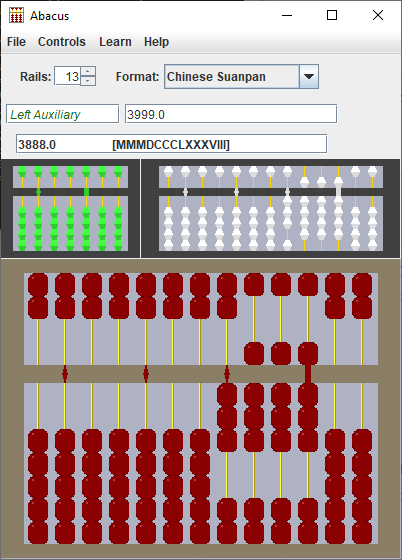
Java Abacus

java -jar AbacusApp.jar -lee=1
Screenshot shown here running as: "java -jar AbacusApp.jar -lee=1"

The query seems to combine two very different requests: a search for a specific thermodynamics solutions manual and a request for an interesting story. 1. Ingeniería Termodinámica (Jones & Dugan)

Assumptions: Stating whether the process is steady-state, involves ideal gases, or is adiabatic. Governing Equations: Applying the First Law ( ) or Second Law of Thermodynamics.

  1. Problema 2: Un motor térmico opera entre dos depósitos de calor a temperaturas de 1000 K y 500 K. Si el motor recibe 1000 kJ de calor del depósito caliente y realiza un trabajo de 400 kJ, se pide calcular la eficiencia del motor.

Propiedades de sustancias puras: Uso de tablas de vapor y diagramas de fases.

Subject: Solucionario Ingeniería Termodinámica Jones Dugan 134

The Demon of MaxwellIn 1867, physicist James Clerk Maxwell proposed a thought experiment to "violate" the Second Law of Thermodynamics (which says entropy always increases). He imagined a tiny "demon" guarding a door between two chambers of gas. The demon would open the door only for fast-moving molecules to enter one side and slow ones to enter the other, effectively lowering entropy without doing "work."

  1. Problem Identification: Clearly identify the problem to be solved and the given parameters.
  2. Fundamental Principles: Recall the fundamental principles of thermodynamics, including the first and second laws of thermodynamics, thermodynamic properties, and heat transfer.
  3. Mathematical Formulation: Formulate the problem mathematically using the relevant equations and principles.
  4. Solution and Analysis: Solve the problem and analyze the results.

You can download the jar file (preserve the .jar extension), and then it can be run as an application like "java -jar AbacusApp.jar -rails=15" or "java -jar AbacusApp.jar -lee=1 -leftAuxRails=9 -rightAuxRails=9". The X Manual Page is written for the X version but may be useful to understanding the Java program.

Java Abacus Abacus Implementation for Java
Icon Source Code Jar File
abacus.zip AbacusApp.jar

There is a feature for teachers to test students on the use the abacus. This would give the ability to create your own tests. Results would go into a results directory. Sample tests are given in zip file (there is only the one test so far). The idea is to move the beads to the correct position and then record the answer by a certain time.

See project notes for todo list and history.

X Abacus (and Windows too)

Still my favorite Abacus Abacus Implementation for X (Linux and friends) and Windows
Icon Latest Source Latest Windows Man Page README LSM Older Versions Ancient Versions
xabacus-latest.tar.xz wabacus-latest.zip xabacus xabacus.README xabacus.lsm At SillyCycle At Ibiblio

NewA Transparent Abacus
Cat behind Abacus


Latest UNIX/VMS version is 8.9.3 and was written in C/C++. Windows version has same source and compiled with MinGW (though does have less features).

See project notes for todo list and history.

Notes

Learning the Abacus
ABACUS Guide Book
HOW TO LEARN LEE'S ABACUS
Books by Takashi Kojima
The Japanese Abacus, Its Use and Theory
Advanced Abacus Japanese Theory and Practice
The Abacus
Salamis Tablet
TOMOE Soroban
Short story by Isaac Asimov The Feeling of Power
Rhymes with Orange Cartoon 2011-08-22 (on 12th page)

Send comments/suggestions to:

Maintainer's Home Page
Last Revised: 2 March 2026